- Batch HPLC tested at 98.5%+ purity.
- Store frozen long term or refrigerated when ready for use.
- Sold for research purposes only.
- Contact us for wholesale orders.
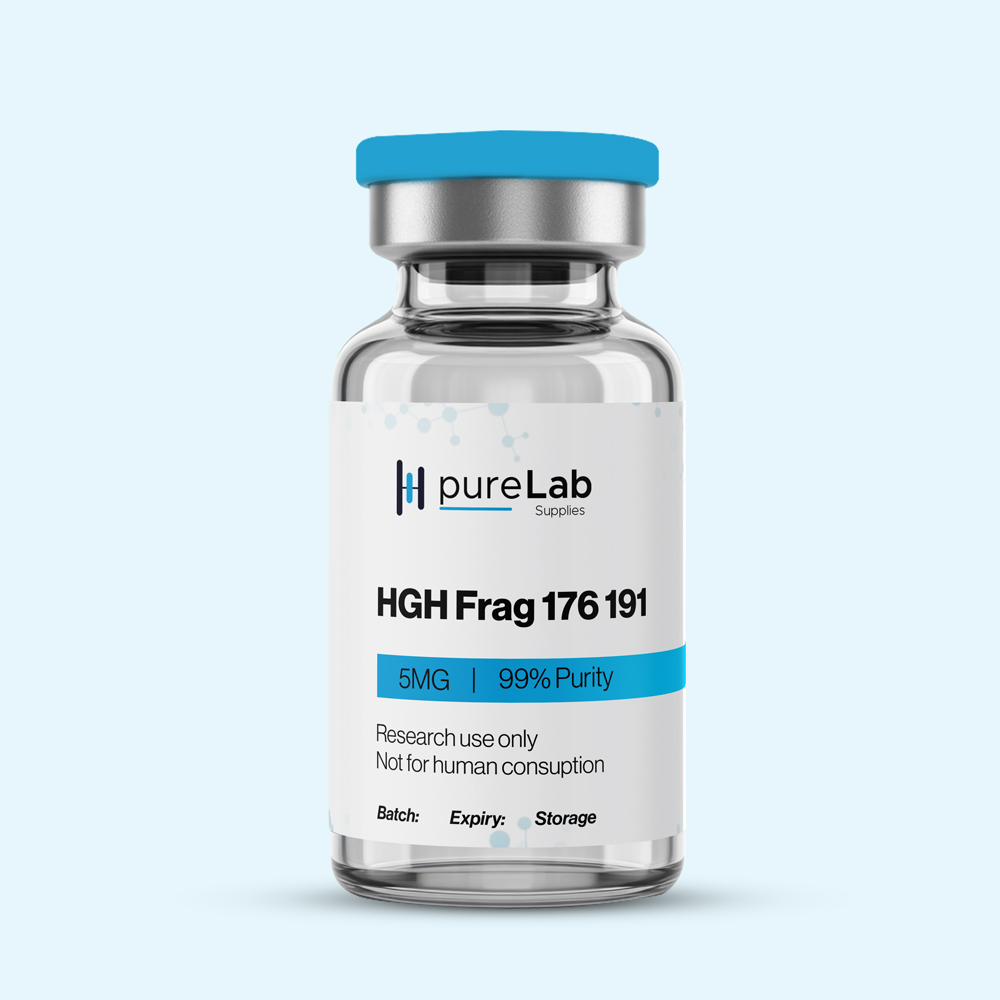
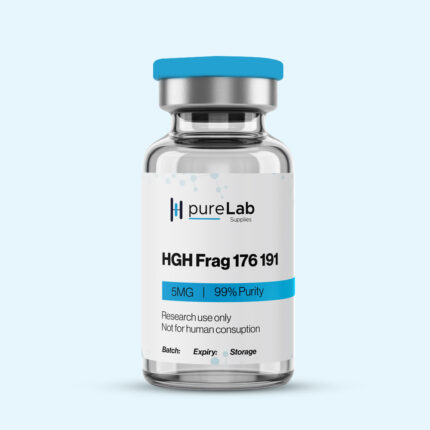
HGH Fragment 176–191
Synonyms / Designations: HGH Frag 176–191, hGH Fragment 176–191, Modified hGH C-terminal fragment
CAS Number: 66004-57-7
Molecular Formula: C78H123N23O22S2
Molecular Weight: ~1817.12 g/mol
Peptide Classification: Synthetic peptide fragment derived from human growth hormone (C-terminal region)
Purity: ≥99% (HPLC, typical)
Appearance: White to off-white lyophilised powder
Storage: Desiccated, protected from light, stored at –20 °C
Solubility: Soluble in sterile water and buffered aqueous solutions
Description & Mechanism
HGH Fragment 176–191 is a synthetic peptide corresponding to amino acids 176–191 of the C-terminal region of human growth hormone (hGH). It represents a structurally defined fragment of the parent protein and is utilised in research settings to investigate domain-specific peptide behaviour independent of full-length hormone activity.
In biochemical and cellular research models, HGH Fragment 176–191 has been examined for its interactions with receptors, enzymes, and signalling pathways associated with growth hormone-related molecular systems. Studies typically focus on fragment-specific binding characteristics, intracellular signalling responses, and comparative behaviour relative to intact hGH. Observed effects are dependent on experimental design, concentration, and model system, and are used to explore structure–function relationships rather than defined physiological outcomes.
Applications in Research
- As a molecular tool for studying structure–function relationships of growth hormone-derived peptides.
- Investigation of fragment-specific receptor interactions and signalling pathways.
- In vitro studies comparing peptide fragments to full-length growth hormone.
- Use as a reference compound in endocrine and peptide signalling research.
Handling, Reconstitution & Stability
- Weigh under dry conditions; peptide is hygroscopic.
- Reconstitute in sterile water or an appropriate buffered aqueous solution depending on assay requirements.
- Avoid vigorous agitation during dissolution.
- Filter sterilise if required (e.g. 0.22 µm) immediately prior to use.
- Aliquot and store reconstituted solutions at –20 °C (or lower) to minimise degradation.
- Avoid repeated freeze–thaw cycles.
Precautions & Notes
- Experimental behaviour of HGH Fragment 176–191 is dependent on concentration, exposure duration, and experimental model.
- Fragment peptides may exhibit properties distinct from the full-length parent hormone.
- Buffer composition, pH, and ionic strength may influence peptide stability and assay performance.
- Appropriate controls are recommended to distinguish fragment-specific from non-specific effects.
- Intended strictly for laboratory research use; not for human or veterinary application.
References
- Wu, Z. et al. The C-terminal fragment 177–191 of growth hormone (GH) can also induce lipolysis in 3T3-L1 adipocytes. Molecular and Cellular Endocrinology, 1993.
https://pubmed.ncbi.nlm.nih.gov/8100717/
- Ng, F. M. et al. Lipolytic action of human growth hormone and its C-terminal fragment in adipocytes. Journal of Molecular Endocrinology, 1995.
https://pubmed.ncbi.nlm.nih.gov/8583208/
- Heffernan, M. A. et al. Effects of oral administration of a synthetic fragment of human growth hormone on lipid metabolism. American Journal of Physiology – Endocrinology and Metabolism, 2000.
https://pubmed.ncbi.nlm.nih.gov/10862777/
Keywords: HGH Fragment 176–191, hGH Fragment, Growth Hormone Peptide Fragment, Synthetic Peptide.
 Free UK delivery over £500 · Order before 2pm for same-day dispatch
 Every batch third-party tested · 99%+ purity
 For research use only · Not for human consumption