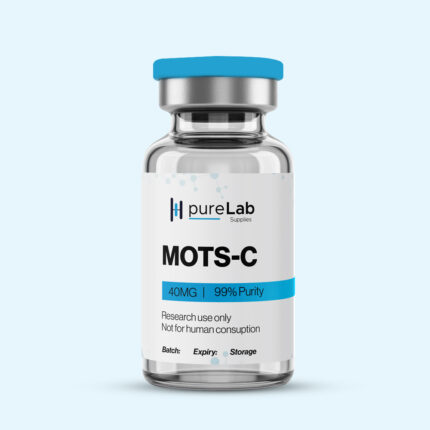
- Batch HPLC tested at 98.5%+ purity
- Store frozen long term or in fridge when ready to be used
- Sold for research purposes only
- Contact us for Wholesale Orders
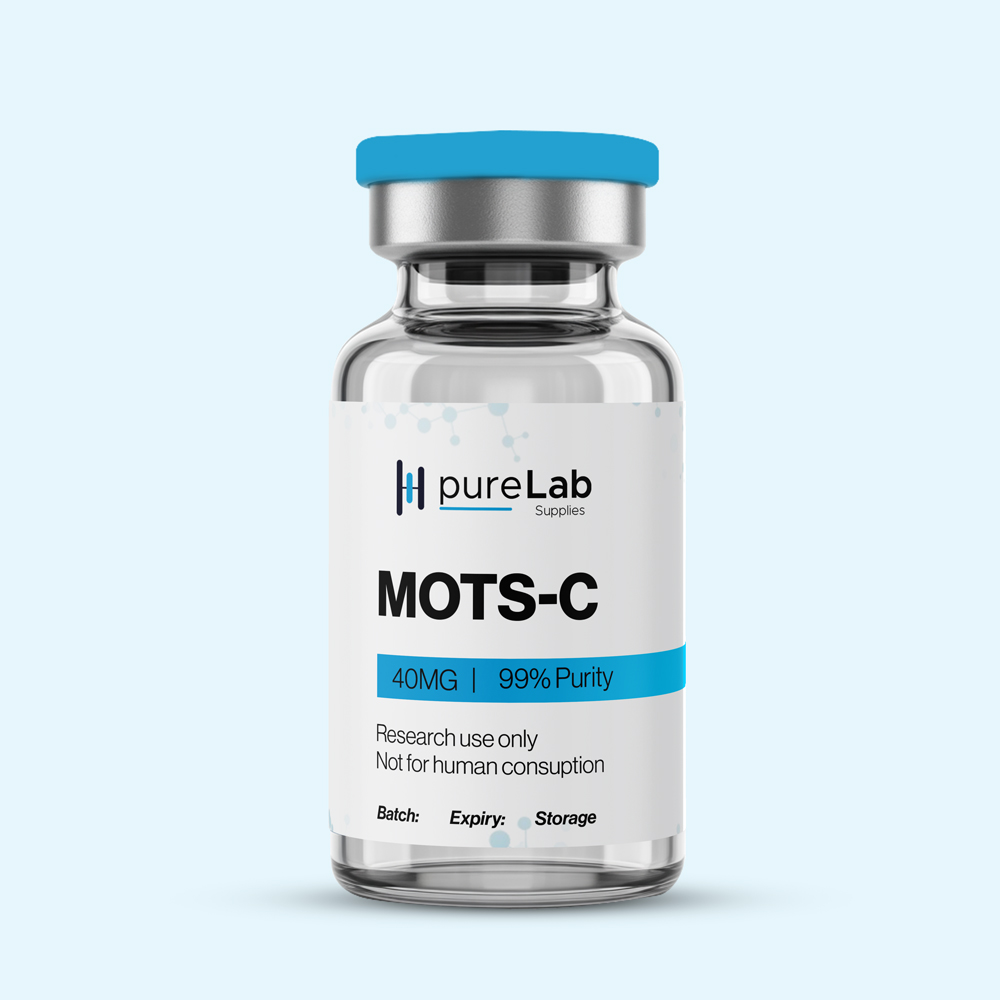
MOTS-c
Synonyms / Designations: MOTS-c, Mitochondrial ORF of the Twelve S rRNA-c
CAS Number: 1627580-64-6
Molecular Formula: C101H152N28O22S2
Molecular Weight: ~2174.64 g/mol
Peptide Length: 16 amino acids
Peptide Type: Mitochondrial-derived regulatory peptide
Purity: ≥ 99% (HPLC, typical)
Appearance: White to off-white lyophilised powder
Storage: Desiccated, protected from light, stored at –20 °C or below
Solubility: Soluble in water and buffered aqueous solutions
Description & Mechanism
MOTS-c is a synthetic peptide corresponding to a naturally occurring mitochondrial-derived peptide encoded within the mitochondrial 12S rRNA region. It is used in experimental research to investigate mitochondrial signalling, metabolic regulation, and nuclear–mitochondrial communication pathways.
In biochemical and cellular research systems, MOTS-c has been investigated for its interactions with intracellular signalling pathways associated with energy sensing, insulin signalling, and cellular stress responses. Experimental models examine its effects on AMPK-associated signalling, metabolic gene expression, and adaptive stress pathways. Observed molecular responses depend on concentration, exposure duration, and experimental model and are used to investigate mitochondrial signalling rather than defined physiological outcomes.
Applications in Research
- As a molecular probe for studying mitochondrial-derived peptide signalling.
- Investigation of metabolic regulation and energy homeostasis pathways.
- In vitro studies examining mitochondrial–nuclear communication.
- Use as a reference compound in metabolism and mitochondrial biology research.
Handling, Reconstitution & Stability
- Weigh under dry conditions; peptide is hygroscopic.
- Reconstitute in sterile water or appropriate buffered aqueous solution.
- Avoid vigorous agitation during dissolution.
- Filter sterilize if required prior to use.
- Aliquot and store reconstituted solutions at –20 °C or lower.
- Avoid repeated freeze–thaw cycles.
Precautions & Notes
- Experimental behaviour of MOTS-c is influenced by metabolic state, cell type, and peptide concentration.
- Buffer composition, pH, and ionic strength may affect peptide stability.
- Appropriate controls are recommended.
- Intended strictly for laboratory research use; not for human or veterinary application.
References
Lee C. et al. The mitochondrial-derived peptide MOTS-c promotes metabolic homeostasis and reduces obesity and insulin resistance. Cell Metabolism, 2015.
https://pubmed.ncbi.nlm.nih.gov/25738459/
Reynolds J.C. et al. MOTS-c is an exercise-induced mitochondrial-encoded regulator of age-dependent physical decline and muscle homeostasis. Nature Communications, 2021.
https://pubmed.ncbi.nlm.nih.gov/33446706/
Kim K.H. et al. Mitochondrial-derived peptides as novel regulators of metabolism. Journal of Physiology, 2017.
https://pubmed.ncbi.nlm.nih.gov/28488752/
Keywords: MOTS-c, Mitochondrial Peptide, Metabolic Regulation, AMPK Signalling, Synthetic Peptide
 Free UK delivery over £500 · Order before 2pm for same-day dispatch
 Every batch third-party tested · 99%+ purity
 For research use only · Not for human consumption