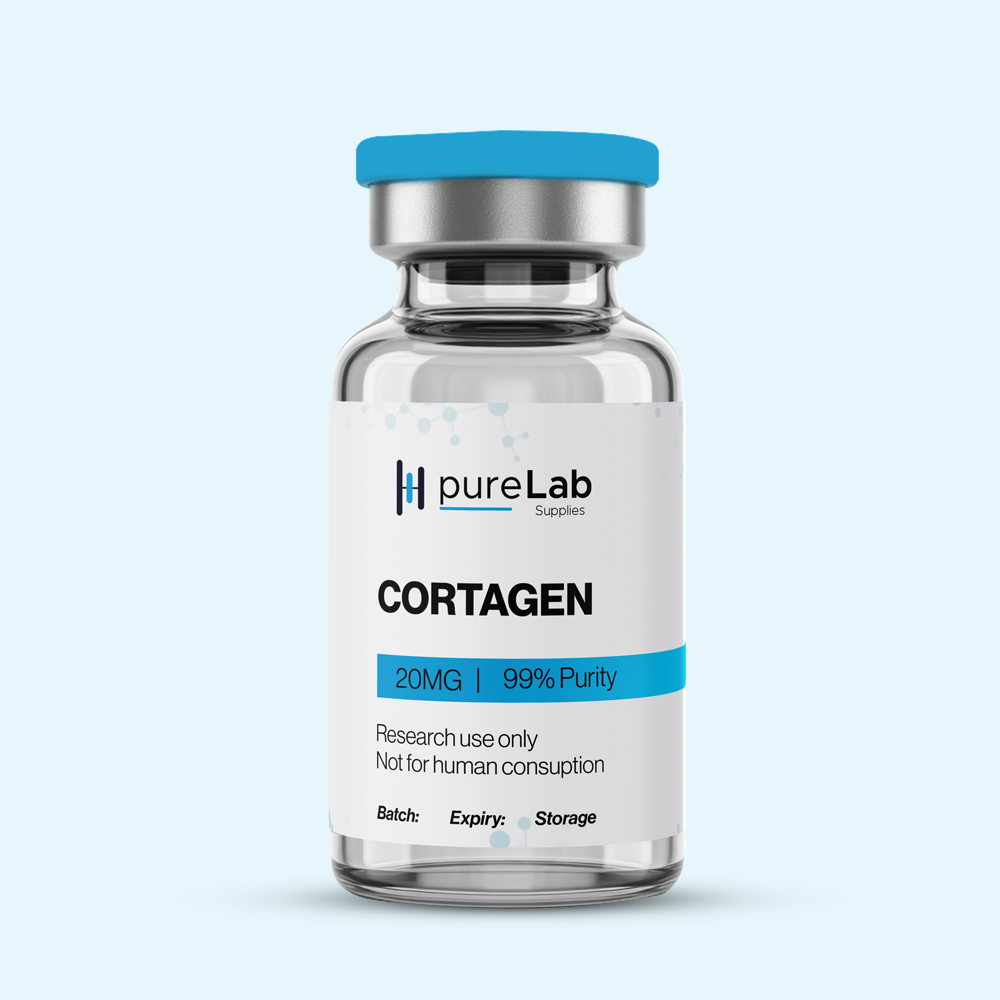
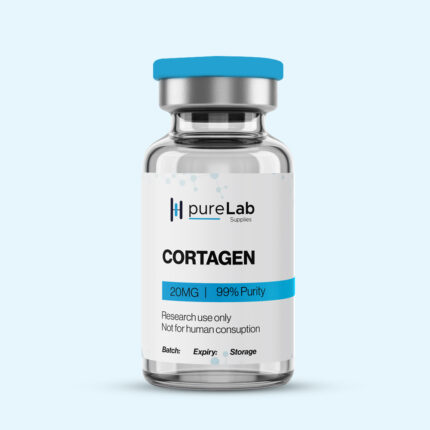
- Batch HPLC tested at 98.5%+ purity
- Store frozen long term or in fridge when ready to be used
- Sold for research purposes only
- Contact us for Wholesale Orders
Cortagen
Synonyms / Designations: Cortagen; AEDP; brain cortex peptide bioregulator; synthetic short-peptide analogue of Cortexin
Amino Acid Sequence: Ala-Glu-Asp-Pro (AEDP)
CAS Number: N/A
Molecular Formula: C17H26N4O9
Molecular Weight: 430.41 g/mol
Purity: ≥ 99 % (HPLC)
Appearance: White to off-white lyophilised powder
Storage: Desiccated, protected from light, stored at –20 °C or below
Solubility: Soluble in water and buffered aqueous solutions
Description & Mechanism
Cortagen is a short synthetic tetrapeptide, designed on the basis of amino-acid analysis of the cortical polypeptide preparation Cortexin, used as a molecular probe for studying tissue-specific gene regulation in nervous-tissue model systems. In experimental settings it is applied to neuronal and glial cultures and to peripheral-nerve regeneration models to examine neurotrophic gene expression, cell proliferation and neurite outgrowth.
In line with the Khavinson short-peptide paradigm, Cortagen is studied as a candidate cell-penetrating regulator that may bind DNA/histones and modulate promoter activity. It serves as a research tool for probing transcriptional mechanisms in experimental neuroscience preparations; observed effects depend on concentration, model system and exposure conditions.
Applications in Research
- Preclinical rodent peripheral-nerve regeneration models (e.g. sciatic-nerve transection)
- In-vitro neuronal / glial culture gene-expression and neurite-outgrowth assays
- Cellular models of neuroprotection and oxidative stress
- Probe for short-peptide transcriptional regulation in neural tissue
Handling, Reconstitution & Stability
- Weigh under dry conditions; peptide is hygroscopic
- Reconstitute in sterile water or appropriate buffered aqueous solution depending on assay requirements
- Avoid vigorous agitation during dissolution
- Filter sterilize if required (e.g. 0.22 µm) prior to use
- Aliquot and store reconstituted solutions at –20 °C or below to minimise degradation
- Avoid repeated freeze–thaw cycles
Precautions & Notes
- Experimental behaviour is dependent on concentration, model system and exposure conditions
- Appropriate experimental controls are recommended
- Prolonged exposure to light, elevated temperature or aqueous environments may reduce stability
- Intended strictly for laboratory research use; not for human or veterinary application
References
Turchaninova VV, Kolosova LI, et al. Effect of tetrapeptide cortagen on regeneration of sciatic nerve. Bull Exp Biol Med.
https://link.springer.com/article/10.1007/BF02682018
Khavinson VKh, Linkova NS, et al. Short cell-penetrating peptides: a model of interactions with gene promoter sites.
https://pubmed.ncbi.nlm.nih.gov/23484211/
Khavinson VKh, Popovich IG, et al. Peptide Regulation of Gene Expression: A Systematic Review. Molecules. 2021;26(22):7053.
https://www.mdpi.com/1420-3049/26/22/7053
Keywords: Cortagen, AEDP, brain cortex peptide bioregulator, synthetic tetrapeptide
 Free UK delivery over £500 · Order before 2pm for same-day dispatch
 Every batch third-party tested · 99%+ purity
 For research use only · Not for human consumption