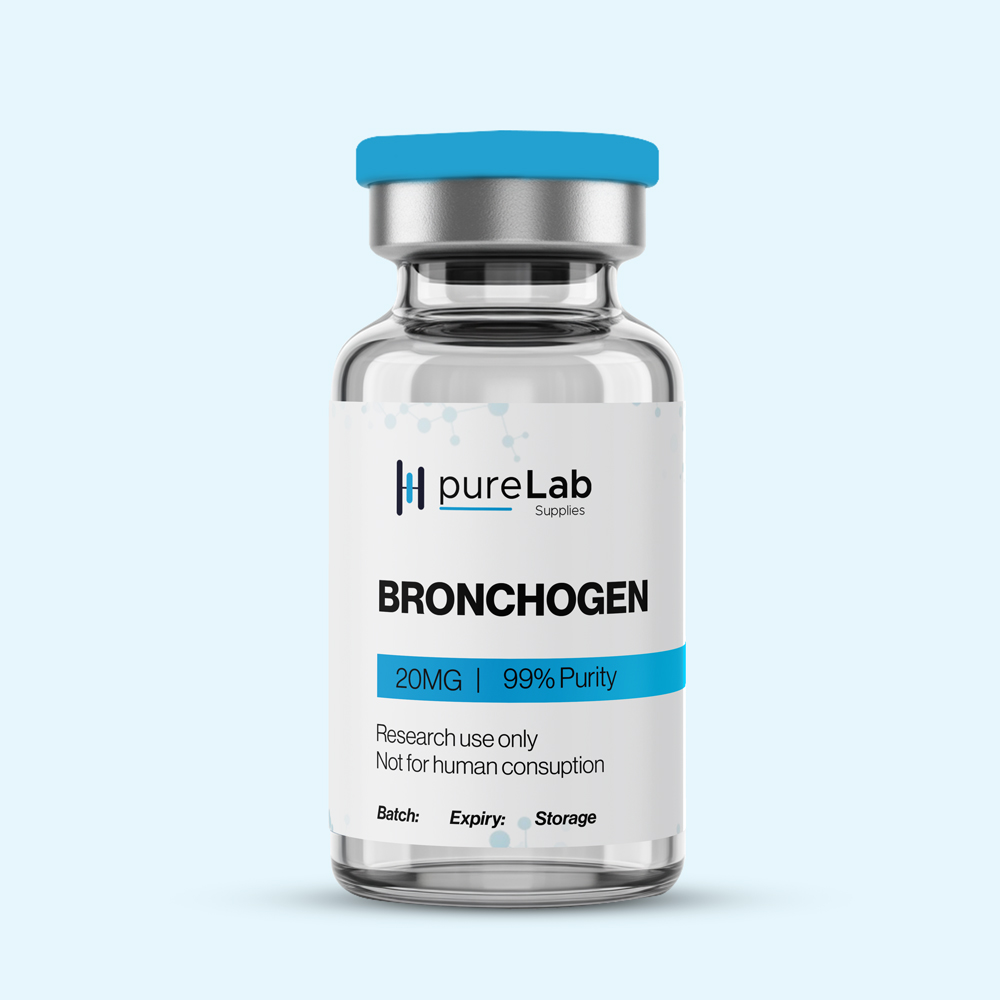
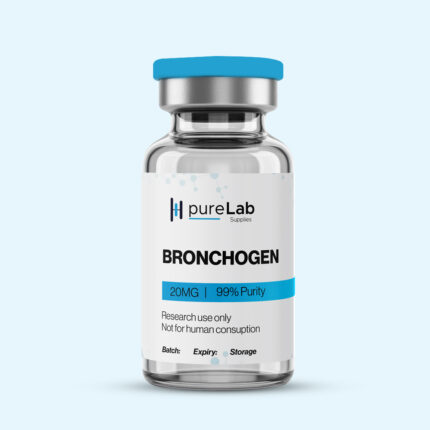
- Batch HPLC tested at 98.5%+ purity
- Store frozen long term or in fridge when ready to be used
- Sold for research purposes only
- Contact us for Wholesale Orders
Bronchogen
Synonyms / Designations: Bronchogen; AEDL; ADEL; lung (bronchial) peptide bioregulator
Amino Acid Sequence: Ala-Asp-Glu-Leu (ADEL, per primary literature; commonly designated AEDL)
CAS Number: N/A
Molecular Formula: C18H30N4O9
Molecular Weight: 446.45 g/mol
Purity: ≥ 99 % (HPLC)
Appearance: White to off-white lyophilised powder
Storage: Desiccated, protected from light, stored at –20 °C or below
Solubility: Soluble in water and buffered aqueous solutions
Description & Mechanism
Bronchogen is a short synthetic tetrapeptide used as a molecular probe for studying tissue-specific regulation of gene expression in bronchial-epithelium model systems. In cultured human bronchial epithelial cells it has been reported to modulate transcription of mucin and surfactant-associated genes (MUC4, MUC5AC, SFTPA1) and to alter levels of proliferation- and apoptosis-associated proteins.
Within the Khavinson short-peptide model, peptides of this class are studied as candidate cell-penetrating regulators that may interact with DNA and chromatin to influence promoter activity. Bronchogen is therefore used to examine putative peptide–DNA interactions and downstream transcriptional readouts in vitro; observed effects depend on concentration, model system and exposure conditions.
Applications in Research
- In-vitro modulation of gene/protein expression in human bronchial epithelial cell cultures (MUC4, MUC5AC, SFTPA1, Ki-67, p53)
- Cellular models of epithelial proliferation, apoptosis and replicative senescence
- Preclinical rodent models of experimental lung inflammation, fibrosis and toxic lung injury
- Probe compound for short-peptide / DNA-promoter interaction studies
Handling, Reconstitution & Stability
- Weigh under dry conditions; peptide is hygroscopic
- Reconstitute in sterile water or appropriate buffered aqueous solution depending on assay requirements
- Avoid vigorous agitation during dissolution
- Filter sterilize if required (e.g. 0.22 µm) prior to use
- Aliquot and store reconstituted solutions at –20 °C or below to minimise degradation
- Avoid repeated freeze–thaw cycles
Precautions & Notes
- Experimental behaviour is dependent on concentration, model system and exposure conditions
- Appropriate experimental controls are recommended
- Prolonged exposure to light, elevated temperature or aqueous environments may reduce stability
- Intended strictly for laboratory research use; not for human or veterinary application
References
Khavinson VKh, et al. Peptide regulation of gene expression and protein synthesis in bronchial epithelium. Lung. 2014;192(5):781-791.
https://pubmed.ncbi.nlm.nih.gov/25015171/
Monaselidze JR, Khavinson VKh, et al. Effect of the peptide bronchogen (Ala-Asp-Glu-Leu) on DNA thermostability. Bull Exp Biol Med. 2011;150(3):375-377.
https://pubmed.ncbi.nlm.nih.gov/21240358/
Khavinson VKh, Popovich IG, et al. Peptide Regulation of Gene Expression: A Systematic Review. Molecules. 2021;26(22):7053.
https://www.mdpi.com/1420-3049/26/22/7053
Keywords: Bronchogen, AEDL, lung peptide bioregulator, synthetic tetrapeptide
 Free UK delivery over £500 · Order before 2pm for same-day dispatch
 Every batch third-party tested · 99%+ purity
 For research use only · Not for human consumption