- Batch HPLC tested at 98.5%+ purity.
- Store frozen long term or in fridge when ready to be used.
- Sold for research purposes only.
- Contact us for Wholesale Orders.
- Search our database for full COA analytics here.
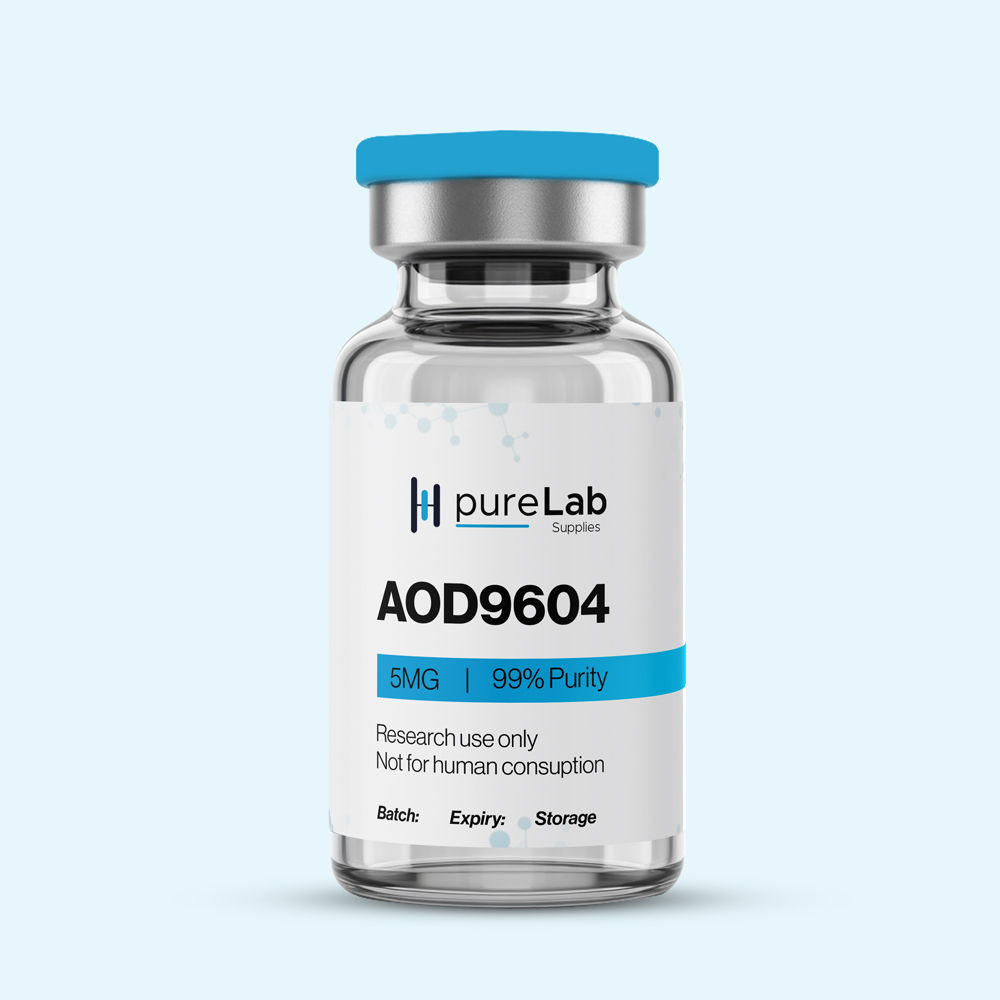
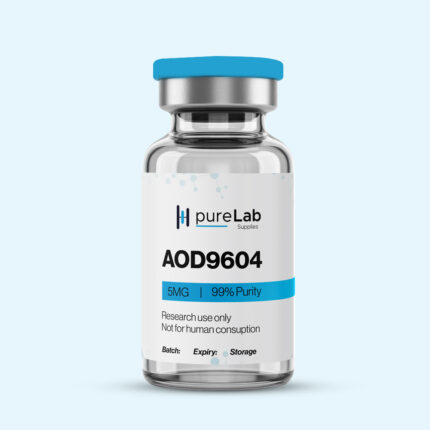
AOD9604
Synonyms / Designations: AOD9604, Synthetic hGH Fragment (176–191), Modified C-terminal Growth Hormone Peptide.
CAS Number: 221231-10-3.
Molecular Formula: C78H123N23O23S2.
Molecular Weight: ~1,815.1 g/mol.
Purity: ≥ 99 % (HPLC).
Appearance: White to off-white lyophilised powder.
Storage: Desiccated, protected from light, stored at –20 °C or below.
Solubility: Soluble in water and buffered aqueous solutions.
Description & Mechanism
AOD9604 is a synthetic peptide derived from the C-terminal fragment (residues 176–191) of human growth hormone (hGH), with sequence modifications introduced to enhance stability and research utility. Unlike full-length growth hormone, AOD9604 does not directly activate the growth hormone receptor but is studied as a discrete molecular fragment with distinct biological activity in experimental systems.
In biochemical and cellular research models, AOD9604 is used to investigate growth hormone–related signalling pathways that are independent of classical GH receptor activation. Preclinical studies have shown that this peptide fragment can influence pathways associated with lipid metabolism and intracellular signalling without eliciting broad growth hormone–mediated effects. Observed outcomes are dependent on experimental context, concentration, and model design, making AOD9604 a useful tool for mechanistic studies examining domain-specific activity of growth hormone–derived peptides.
Applications in Research
As a molecular tool to study growth hormone fragment–specific signalling mechanisms.
Investigation of lipid metabolism–associated pathways in cellular and biochemical models.
In vitro studies examining receptor-independent growth hormone signalling.
Preclinical or ex vivo research exploring structure–function relationships of GH-derived peptides.
Handling, Reconstitution & Stability
- Weigh under dry conditions; peptide is hygroscopic.
- Reconstitute in sterile water or appropriate buffered aqueous solution depending on assay requirements.
- Avoid vigorous agitation during dissolution.
- Filter sterilize if required (e.g. 0.22 µm) prior to use.
- Aliquot and store reconstituted solutions at –20 °C or below to minimise degradation.
- Avoid repeated freeze–thaw cycles.
Precautions & Notes
- AOD9604 activity is concentration- and context-dependent; appropriate dose–response controls are recommended.
- As a peptide fragment, behaviour may differ from full-length growth hormone in receptor or signalling assays.
- Prolonged exposure to light, elevated temperature, or aqueous environments may reduce stability.
- Intended strictly for laboratory research use; not for human or veterinary application.
References
Chance W.T. et al. Pancreatic polypeptide and its fragments: receptor interactions and biological activity. Peptides, 1995.
https://pubmed.ncbi.nlm.nih.gov/8594255/
Michel M.C. et al. Neuropeptide Y and pancreatic polypeptide receptors. Pharmacological Reviews, 1998.
https://pubmed.ncbi.nlm.nih.gov/9597167/
Balasubramaniam A. Pancreatic polypeptide and related peptides. Endocrine Reviews, 2003.
https://pubmed.ncbi.nlm.nih.gov/12700199/
Keywords: AOD9604, hGH Fragment 176–191, Growth Hormone Peptide, Modified C-terminal Growth Hormone Peptide.
 Free UK delivery over £500 · Order before 2pm for same-day dispatch
 Every batch third-party tested · 99%+ purity
 For research use only · Not for human consumption